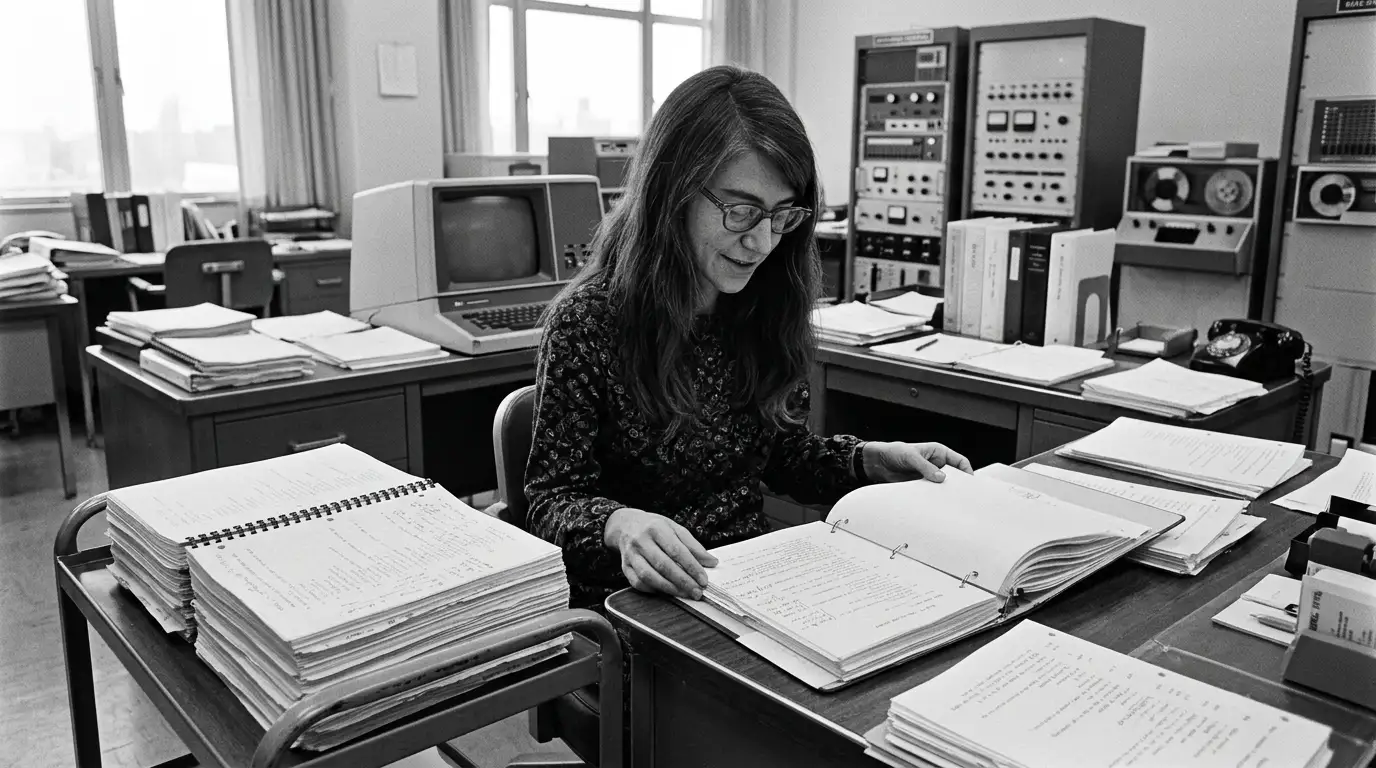
Margaret Hamilton was the MIT computer scientist who led the team developing NASA’s Apollo onboard flight software. Her work helped make the Apollo 11 lunar landing possible and helped establish software engineering as a serious engineering discipline.
Margaret Hamilton at NASA: Quick Facts
| Fact | Detail |
|---|---|
| Full name | Margaret Heafield Hamilton |
| Born | August 17, 1936 |
| Birthplace | Paoli, Indiana |
| Education | Earlham College, mathematics; minor in philosophy |
| Apollo role | Leader of the software engineering effort at MIT’s Instrumentation Laboratory |
| Apollo period | Joined the Apollo software project in 1965 |
| Best known for | Onboard flight software and error-handling systems |
| Major NASA recognition | NASA Exceptional Space Act Award, 2003 |
| Presidential honor | Presidential Medal of Freedom, 2016 |
| Later career | Founded Higher Order Software and Hamilton Technologies |
| Died | September 30, 2026, age 90 |
MIT confirmed Hamilton’s death on October 7, 2026. The institute said she died September 30 at age 90; it did not disclose a cause of death.
Who Was Margaret Hamilton?
Hamilton was an American computer scientist, mathematician and software engineering pioneer whose career developed alongside the early computer industry.
She was born in Indiana in 1936 and initially studied mathematics at the University of Michigan before transferring to Earlham College. She graduated from Earlham in 1958 with a mathematics degree and a minor in philosophy.
Hamilton moved to Massachusetts in 1959 and began working at MIT. One of her early programming assignments involved weather prediction with meteorologist Edward N. Lorenz. She later worked at MIT Lincoln Laboratory on SAGE, a large early air-defense system. That experience gave her an unusually strong interest in making software reliable and capable of handling unexpected situations.
That concern with reliability became central to her most famous work.
What Did Margaret Hamilton Do for NASA?
One detail is often simplified in biographies: Hamilton was not an astronaut, and her Apollo work was carried out through MIT rather than as a conventional NASA staff position.
MIT’s Instrumentation Laboratory had a NASA contract to develop the guidance and control systems for Apollo. Hamilton joined the Apollo software effort in 1965 and eventually led its Software Engineering Division. Her teams developed onboard flight software for the command and lunar modules, including systems designed to detect problems, recover from them and keep essential tasks running.
By the late 1960s, the work involved a large engineering organization. Hamilton’s role was not simply writing individual lines of code. She helped shape how the software should behave when the spacecraft, its computer or its operating conditions did not follow the expected script.
That approach was unusually forward-looking for an era when software was still treated by many organizations as secondary to hardware.
How Margaret Hamilton’s Software Helped Apollo 11
The moment most closely associated with Hamilton came during the Apollo 11 landing on July 20, 1969.
As the lunar module Eagle descended toward the Moon, its Apollo Guidance Computer began issuing 1202 program alarms. The alarms indicated that the computer was being overloaded. In a situation like that, the spacecraft could have lost the ability to perform critical landing functions.
The problem was connected to the rendezvous radar system. A switch had been left in a position that caused the computer to process additional radar-related work at a time when its resources were already heavily committed. NASA’s historical record explains that the software was designed with a priority-driven system rather than requiring every task to receive equal processing time.
That design mattered.
The computer could discard or postpone lower-priority jobs while continuing the calculations required for the landing. The system also included restart and recovery mechanisms. In other words, the software was built with overload in mind rather than assuming everything would always proceed normally.
Mission controllers determined that the computer could continue operating and gave the astronauts a “go” decision. Eagle landed safely in the Sea of Tranquility.
It would be misleading to say that Hamilton alone “saved Apollo 11.” The landing depended on a large network of astronauts, flight controllers, hardware engineers, programmers and other specialists. But the incident demonstrated exactly why Hamilton’s software philosophy mattered: the system recognized an overload and protected the functions that mattered most.
Why the 1202 Alarm Was So Important
The Apollo 11 alarm is sometimes described as a simple computer glitch. It was more significant than that.
The Apollo Guidance Computer had extremely limited resources by modern standards. MIT notes that the computer occupied less than one cubic foot, weighed about 70 pounds and used only 55 watts. Engineers therefore had to make careful decisions about how computing time and memory were allocated.
Hamilton’s team designed software that treated reliability as an engineering problem. Priority scheduling, asynchronous operation, testing, error detection and recovery were not afterthoughts. They were built into the system.
That philosophy is one reason her Apollo work remains relevant decades later.
Did Margaret Hamilton Coin the Term “Software Engineering”?
Hamilton is widely credited with popularizing the term software engineering, and she deliberately used it to argue that software development deserved the same engineering discipline applied to hardware and other complex systems. NASA credited her and her team with helping build the foundations of modern software engineering.
Her choice of language reflected a larger problem. In the 1960s, software was a young field with few established standards, methodologies or professional conventions. Hamilton believed complex software needed systematic design, testing and safeguards rather than being treated as an experimental add-on to hardware.
That idea now seems obvious. At the time, it was not.
Margaret Hamilton’s Career After Apollo
Hamilton continued working at MIT’s Instrumentation Laboratory into the 1970s. When the laboratory separated from MIT and became Draper Laboratory, she moved on to the private sector.
In 1976, she founded Higher Order Software, a company based on her approach to error prevention and reliable software development. In 1986, she founded Hamilton Technologies, where she continued developing systems and software engineering methods.
Her career therefore did not end with Apollo. The Moon missions were the work that made her famous, but her larger contribution was the development of methods for building dependable software in situations where failure could have serious consequences.
Margaret Hamilton’s Awards and Legacy
Hamilton received major recognition later in her career.
NASA gave her the Exceptional Space Act Award in 2003 for her scientific and technical contributions. NASA specifically cited concepts including asynchronous software, priority scheduling, end-to-end testing and human-in-the-loop decision capability as important contributions to reliable software design.
In 2016, President Barack Obama awarded Hamilton the Presidential Medal of Freedom, the nation’s highest civilian honor. The White House recognized her leadership in developing Apollo’s onboard flight software and her broader influence on software engineering.
She was also inducted into the National Aviation Hall of Fame in 2022.
Her famous 1969 photograph, showing her beside the towering stack of printed Apollo software, eventually became an enduring image of the early computer age. The photograph was taken at MIT by an Instrumentation Laboratory staff photographer and was originally intended to promote the lab’s Apollo work.
That image is memorable, but the deeper legacy is in the engineering ideas behind it.
Why Margaret Hamilton Still Matters
Margaret Hamilton’s importance extends beyond the first Moon landing.
She helped demonstrate that software could not be treated as something secondary to machines. For systems that had to work under extreme conditions, software needed architecture, testing, recovery strategies and clear priorities.
That principle now underpins everything from spacecraft and aircraft to medical systems and industrial controls.
Hamilton also showed what software engineering looked like before the profession had fully formed. She was designing reliable, mission-critical software at a time when there were no mature textbooks or established playbooks for the kind of work Apollo demanded. MIT’s account of her career describes that period as one in which the team had to create solutions as they went.
Margaret Hamilton died on September 30, 2026, but the software principles she helped advance did not disappear with the Apollo program. Her work remains part of the history of both NASA’s Moon missions and modern computing.
FAQs
Who was Margaret Hamilton at NASA?
Margaret Hamilton was an MIT computer scientist who led the team responsible for Apollo onboard flight software under MIT’s NASA contract. She was a key figure in the development of the software used by Apollo command and lunar modules.
Did Margaret Hamilton really help save Apollo 11?
Yes, but the achievement belonged to a large Apollo engineering team rather than to Hamilton alone. The software Hamilton’s group developed could prioritize critical tasks and recover from computer overload, which helped Apollo 11 continue its lunar landing after the 1202 alarms.
Did Margaret Hamilton invent the term “software engineering”?
Hamilton is widely credited with popularizing and defining the term as she argued that software should be treated as an engineering discipline. NASA and the National Aviation Hall of Fame both connect her career directly with the emergence of software engineering.
When did Margaret Hamilton die?
Margaret Hamilton died on September 30, 2026, at age 90. MIT announced her death on October 7, 2026, and said the cause of death was not disclosed.
Source list
- MIT News: Margaret Hamilton, computing pioneer who led software development for the Apollo program, dies at 90, Access Date: October 8, 2026
- NASA Science: Margaret Hamilton, Access Date: October 8, 2026
- NASA History: Apollo 11 Lunar Surface Journal: Program Alarms, Access Date: October 8, 2026
- NASA History: Margaret Hamilton, Access Date: October 8, 2026
- MIT News: Scene at MIT: Margaret Hamilton’s Apollo code, Access Date: October 8, 2026
- The White House Archives: President Obama Names Recipients of the Presidential Medal of Freedom, Access Date: October 8, 2026
- National Aviation Hall of Fame: Margaret Hamilton, Access Date: October 8, 2026
- Earlham College: Margaret Hamilton ’58 to receive honorary Doctor of Science at Commencement, Access Date: October 8, 2026
About the Author